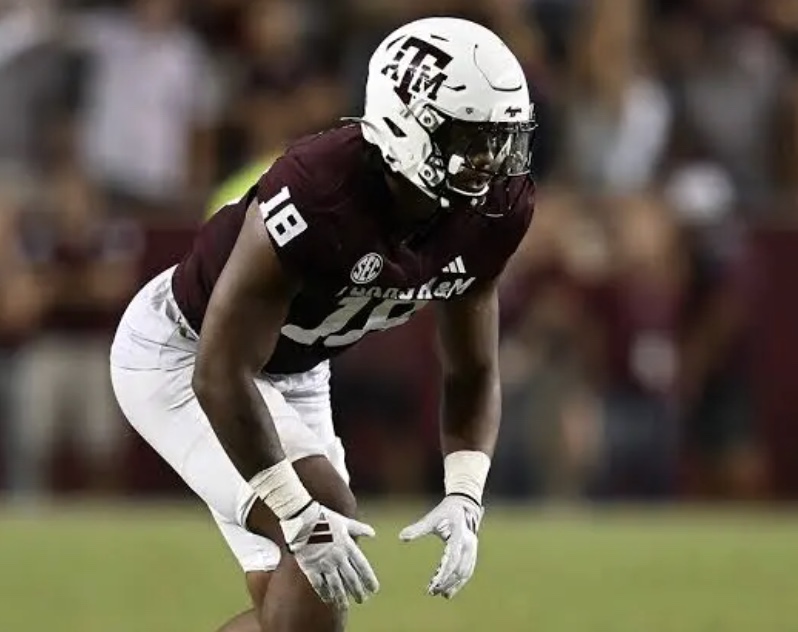
Maybe the biggest college football news story of the week was LSU firing head coach Brian Kelly after a devastating loss to Texas A&M last weekend. One of the biggest reasons for this was Cashius Howell, who had two sacks and was in the backfield, making an impact the entire game. Howell was dominating against the young LSU tackles, and it seemed the Tigers did not have an answer for him the entire game.
This game helped Howell get to 9.5 total sacks on the season, and has propelled him into the conversation to be a first-round pick this summer. Howell has elite burst and may have the best first step of any edge rusher in the 2026 class. He also performs one of the best ghost moves I have ever seen from a college prospect, and that move is what helped him dominate against LSU.
The concern that scouts will have with Howell is simple… His size. Howell comes in at 6’2/250, which on its own is not all that concerning, but at senior weigh-ins, his arms measured at 31 inches, well under the 33″ threshold that scouts are looking for. But now, the question for Howell becomes: How much does arm length matter in the NFL, and how much will it hold back his draft stock?
31-inch arms for an edge rusher is beyond an outlier, and there are almost no active NFL edge rushers with arms under 31 inches. To be honest, Calijah Kancey is the last defensive lineman or edge that I can find with arms under 31 inches, so if Howell comes in at 31 inches or below, it will be a serious concern.
This situation is very similar to the discourse around Kenny Pickett a few years ago, and his abnormally small hands. Many people viewed Pickett as a top prospect at a premium position, but he fell to pick 20 largely because of his smaller hands. Pickett has struggled in his NFL career and has gone from the Steelers to the Eagles, to the Browns, and is now Geno Smith’s backup for the Raiders.
Another example of someone who struggled with their measurements is Will Campbell, who was the top tackle in last year’s draft, but got a lot of criticism for his shorter arms. Campbell’s arms came in at 32 5/8 inches, which would be the seventh percentile, and his 77 3/8 inch wingspan would be the shortest ever recorded. Despite this, Campbell was the top tackle selected in the 2025 NFL draft, and while some other tackle prospects have performed better, it’s too early to tell how Campbell’s career will play out.
It is hard to predict things we have never seen before, and a player like Howell is certainly a unique profile. On film, it appears his smaller arms do not limit his production, and he has an incredible ability to win with speed and power. But what scouts will worry about is how those skills will translate to the NFL.
Let’s be clear… Arm length matters in the NFL, and it has been proven that defensive ends with longer arms have a higher success rate. In the modern NFL, we have seen guys like Nick Herbig, Nik Bonitto, and several others succeed with smaller arms but great burst off the edge. But NFL teams do not like to bet on the anomaly, and that is what Howell is.
Right now, I have Howell graded as my number three OLB in this year’s class, but he grades similarly to the other top players at the position. David Bailey, Damon Wilson Jr, and R Mason Thomas are also OLBs I have graded in my top 50 who I think will have successful NFL careers. You cannot put a value on Howell’s elite speed, burst, and bend off the edge, and I do think he will be successful in the NFL.
Currently, I think Howell is a day two draft pick who will have NFL success, but needs to fit in a very specific scheme. The lack of length will really limit how well Howell can generate power off the edge, and he will need to play in a blitz-heavy 3-4 scheme that is not afraid to use him as a Wide 9 blitzer or even drop him into coverage.
While I think the other OLB prospects may find more success with their physical tools, that does not mean I think Howell will fail. Measurements should impact the way you view a prospect, but at the end of the day, film and production will forever be king. Howell may be limited in his cieling because he will struggle to make first contact and get early leverage, but his speed and burst will allow him to rush the passer at a high level. If this production continues, he should easily be a second round pick in April.


